Inside the Fully Robotic Restaurant at Mobile World Congress


I have seen a lot of wild prototypes at tech expos over the years, but there is something fundamentally mesmerizing about watching a humanoid machine carefully steep and pour a cup of tea without spilling a single drop.
While the floors of the Mobile World Congress are usually dominated by the latest folding smartphones and next-gen network antennas, the absolute showstopper this time around came from an unexpected source: China Mobile. They didn’t just show off a new chip; they built a fully functioning, entirely automated restaurant right on the showroom floor.
I spent some time digging into how this robotic kitchen actually operates, and let me tell you, it completely redefines our concept of fast food. Let’s break down how this robotic crew works, the mind-bending AI behind it, and why a massive telecom giant is suddenly interested in serving you dumplings.
Meet Your New Crew: The 4-Robot Kitchen

When you walk up to this futuristic dining setup, the first thing you notice is the total absence of human staff behind the counter. You place your order via a standard tablet, and the moment you hit “confirm,” the stage belongs entirely to the machines.
The kitchen is operated by a synchronized team of four robots. Here is how they split the workload:
- The Head Waiter (“Lingxi”): This is the star of the show. Lingxi oversees the operation, takes charge of the final delivery, and acts as the face of the restaurant.
- The Chef: A specialized robotic arm dedicated entirely to preparing and cooking fresh dumplings.
- The Barista: A precision-focused bot that handles the delicate task of pouring hot tea.
- The Runner: A support bot whose main job is to fetch cold items, like fresh apples, directly from the refrigerator.
According to the live demonstrations, once an order is placed, this mechanical crew can theoretically complete the entire preparation and serving process in just 2 minutes and 24 seconds. While the actual showcase ran a little slower to let the crowd take videos, the sheer coordination was incredibly smooth.
The 92% Success Rate: A Massive Leap Forward

One detail that really caught my eye in China Mobile’s data was the accuracy rate. The company proudly claims the system operates with a 92% success rate.
Now, if you think about it from a traditional restaurant perspective, messing up roughly one out of every ten orders would probably get a human manager fired. But in the realm of advanced robotics, this is actually a phenomenal achievement.
- The Balance Upgrade: Earlier iterations of service robots were notoriously clumsy. Giving them a tray full of hot liquids was basically asking for a lawsuit.
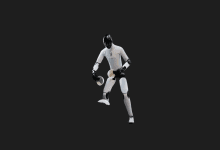
- Precision Handling: The new version of the Lingxi robot has undergone massive upgrades in gyroscopic balance and spatial awareness. It can now navigate tight spaces, carry loaded trays, and serve beverages safely without the chaotic spills we used to see in older tech demos.
China Mobile was quick to emphasize that these machines aren’t here to steal human jobs anytime soon. But honestly, looking at how flawlessly Lingxi navigates that kitchen, the idea of an entirely human-free fast-food joint doesn’t feel like a sci-fi movie plot anymore—it feels like next year’s reality.
The Real Motive: Why is a Telecom Company Cooking?

This is the part I find most fascinating. Why is a telecommunications giant spending millions to build a robotic dumpling stand? The truth is, they have zero interest in becoming the next McDonald’s. This entire restaurant is actually a brilliant disguise for a massive AI and networking flex.
What China Mobile is really showing off is their new Vision-Language-Action (VLA) large AI model and its real-time coordination system.
Here is what is actually happening behind the scenes:
- The Hive Mind: All four robots are connected to the exact same ultra-low-latency network. They aren’t just doing their own thing; they are actively communicating their positions and tasks to each other in real time.
- Avoiding Collisions: Thanks to the VLA-RAI coordination system, the robots know exactly where their “co-workers” are. If the dumpling bot reaches out, the tea bot knows to wait a fraction of a second so their arms don’t crash.
- Speeding Up the Future: The company claims that because of this seamless hive-mind communication, their robotic operation is 1.3 to 1.5 times faster than systems that require human oversight or traditional programming.
My Final Take
When I look at this demo, I don’t just see a quirky way to get lunch. I see the blueprint for the next decade of automated manufacturing, warehousing, and logistics. If China Mobile’s VLA system can coordinate four distinct robots to cook a meal perfectly in under three minutes without crashing into each other, imagine what that same network could do on a massive factory floor or inside a busy hospital.
The tech is finally catching up to our imaginations. The hardware is balancing better, the AI is thinking faster, and the networks are keeping them all perfectly in sync.
Now, I have a question for you. If a fully robotic fast-food drive-thru opened in your city tomorrow, would you trust Lingxi to get your order exactly right, or do you prefer the human touch when it comes to your food? Drop your thoughts down below!
You Might Also Like;